Penalties for Criminal Convictions in Hudson County
Because the New Jersey legal system is complex, the venue of your case often dictates the defense strategy. Whether your matter is currently in the Hudson County Superior Court or a local Municipal Court, we tailor our approach based on the Indictable vs. Municipal Court strategy appropriate for your charges, ensuring that we apply the right pressure at the right stage of the proceedings. Instead of felonies or misdemeanors, New Jersey classifies crimes as either indictable crimes or disorderly persons offenses. New Jersey’s indictable crimes are roughly equivalent to felonies in other states, while disorderly persons offenses and petty disorderly persons offenses are roughly equivalent to misdemeanors in other states.
When it comes to penalizing indictable crimes or disorderly persons offenses, New Jersey courts consider aggravating and mitigating circumstances to determine whether punishments should be harsher or less severe. An aggravating circumstance is a factor that increases the severity of a crime and supports a harsher penalty. A mitigating circumstance is a factor that lessens the severity of a crime and supports a lesser penalty.
Typical penalties for disorderly persons offenses in Hudson County include:
- Petty disorderly persons offenses – Up to 30 days’ jail time and $500 in fines
- Disorderly persons offenses – Up to six months’ jail time and $1,000 in fines
For indictable crimes, judges sentence within the range set for each degree, weighing aggravating and mitigating factors. Some offenses, such as Graves Act firearm crimes, carry mandatory minimum terms. Typical penalties for indictable crimes in New Jersey include:
- Fourth-degree indictable crimes – Up to 18 months’ imprisonment and up to $10,000 in fines
- Third-degree indictable crimes – Three to five years’ imprisonment and up to $15,000 in fines
- Second-degree indictable crimes – Five to 10 years’ imprisonment and up to $150,000 in fines
- First-degree indictable crimes – 10 to 20 years’ imprisonment and up to $200,000 in fines; murder and certain other offenses carry longer terms
In some cases, individuals who are classified as repeat offenders, professional criminals, or hired criminals can face extended prison sentences. The length of a prison sentence for a repeat offender is based on the severity of the crime and any aggravating factors the court considers relevant.
Which Court Will Hear Your Hudson County Case?
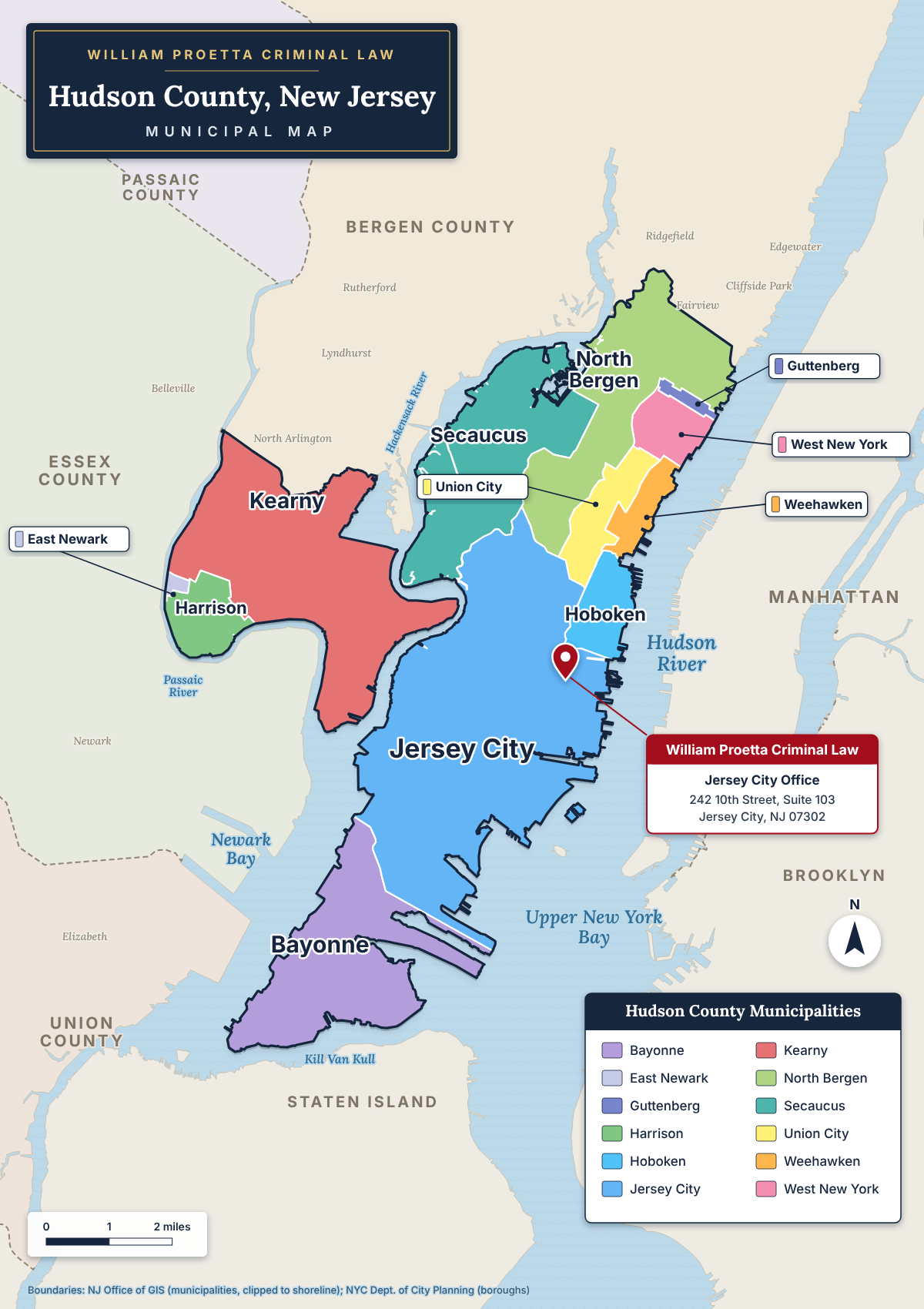
In Hudson County, disorderly persons offenses, traffic tickets, DWI and local ordinance violations stay in the municipal court of the town where they happened. Indictable crimes are prosecuted by the Hudson County Prosecutor’s Office in the Criminal Division of Hudson County Superior Court, at the Frank J. Guarini Justice Complex near Journal Square in Jersey City. A case can start in Bayonne or Hoboken municipal court and move to Jersey City within days, and a charge that is downgraded can come back to the town court.
On the indictable track, the complaint is followed by a first appearance and, if the prosecutor seeks it, a detention hearing. Before any grand jury presentation, the case goes through pre-indictment review, where downgrades, plea offers and PTI are negotiated. After indictment come arraignment, status conferences and motions, and finally trial in Jersey City. Our NJ Criminal Court Roadmap explains each stage.
Ways to Avoid a Conviction in Hudson County
- Pretrial Intervention (PTI) – A supervised Superior Court program for eligible indictable charges. Completing it ends with the charge dismissed.
- Conditional dismissal – A one-time municipal court option for eligible disorderly persons charges. The case is dismissed after a period of supervision.
- Conditional discharge – The municipal court counterpart for eligible first-time drug offenses.
- Veterans Diversion – Treatment and supervision in place of prosecution for eligible veterans and service members.
- Recovery Court – A Superior Court program for defendants whose offenses are tied to substance use, combining treatment with close supervision.
Admission depends on the charge, your record and, for some programs, the prosecutor’s consent.
Paying a Hudson County Ticket or Fighting It
Most Hudson County traffic tickets can be paid on NJMCdirect with the court code shown on your town’s card above, but paying online is a guilty plea: points, MVC surcharges and insurance consequences follow. Hudson courts sit often (Jersey City hears cases Monday through Friday), so first court dates tend to come quickly. Many Hudson tickets are written to drivers from New York and other states. If you live out of state, some matters can be resolved without a return trip, through a written defense by certification if the court approves it.
Criminal Records Can Haunt a Person Beyond the Sentence Itself
If you are convicted of a crime in Hudson County, the conviction will be included in your criminal record. This is one of the many reasons it’s important to get in touch with William Proetta Criminal Law to learn about your options after being charged with an offense in Hudson County. In addition to fines and possible jail time, a conviction on your criminal record can have several long-term consequences, which may impact your:
- Future sentencing – If you are convicted of another indictable crime in the future, having a criminal record could result in harsher penalties than usual.
- Employment – Having a criminal record could harm your chances of being selected for interviews or even exclude you from certain professions entirely.
- Housing – Landlords may refuse to rent to prospective tenants with criminal records, and a conviction may interfere with your ability to get a mortgage.
- Finances – Many lenders consider borrowers with criminal records to be credit risks, so you could have difficulty qualifying for certain types of loans.
- Legal privileges – Certain convictions can result in loss of voting rights, driving privileges, firearm privileges, or the ability to hold public office.
- Travel – Any type of conviction on a criminal record could limit your ability to travel abroad.
- Security clearance – If you need a certain level of security clearance to do your job, your clearance may be revoked or denied in light of a criminal conviction.
- Child custody – A criminal record could cause a family law judge to question your ability to look out for a child’s best interests in a custody dispute.
What Can You Do to Protect Your Rights During and After an Arrest in Hudson County?
When the State’s evidence has been gathered in violation of your constitutional rights, we do not hesitate to act. We have built our reputation on aggressive motion practice and suppression hearings, frequently succeeding in having illegally obtained evidence thrown out, which often results in the dismissal of the entire case. If you have been arrested or detained by Hudson County law enforcement, you can defend your legal rights by:
- Remaining calm and not resisting – Never attempt to run, resist, or obstruct police officers. Keep your hands visible at all times, and never lie to the police or provide them with fake documents.
- Refusing to consent to search requests – If the police ask to search you, chances are they don’t have a warrant. Even if they insist on searching you anyway, you can politely make it clear that you do not consent to the search. Any evidence obtained through illegal searches will likely be inadmissible in court.
- Expressing your wish to remain silent – Let the police know that you wish to remain silent. Do not provide explanations, excuses, or “harmless” details that could jeopardize your case.
- Asking for a lawyer immediately – In addition to exercising your Fifth Amendment rights, tell the police that you want to speak with a lawyer immediately. If the police continue to try to get you to talk, simply repeat your intention to remain silent and your request to speak to a lawyer.
- Remembering the details of the arrest – If you believe your rights were violated at any point, focus on remembering as many details as you can. This includes things like officers’ names, badge numbers, and patrol car numbers.
Hudson County Criminal Court FAQs
Is my Hoboken (or Bayonne, Union City…) case heard in Jersey City?
Only if it’s indictable. Municipal charges stay in the town’s own court; indictable charges go to the Criminal Division of Hudson County Superior Court in Jersey City.
Where is the Hudson County Superior Court, Criminal Division?
At the Frank J. Guarini Justice Complex near Journal Square in Jersey City. The criminal courts moved there in 2026 from the old Administration Building at 595 Newark Avenue.
What does the Hudson County Prosecutor’s Office do after an arrest?
It reviews the charges and decides whether to present the case to a grand jury, downgrade it back to municipal court, or make a plea offer before indictment.
Will I be held in jail until trial?
Usually not. Under New Jersey’s bail reform law, most defendants are released on conditions. The prosecutor can move for pretrial detention in more serious cases, and a judge decides at a detention hearing.
I live out of state. Do I have to come back for a Hudson County ticket?
Not always. Some traffic matters can be handled by a written defense by certification with the court’s approval, and many tickets can be paid online.
What is Hudson County Recovery Court?
A Superior Court program, formerly Drug Court, for eligible defendants whose offenses are tied to substance use.
Talk to a Hudson County Criminal Defense Lawyer Today
When you need a dependable criminal defense attorney in Hudson County, trust your case to the hometown lawyers at William Proetta Criminal Law. We can answer your questions and discuss clear, realistic solutions when you contact us for a free initial case review. Get in touch with us today.